

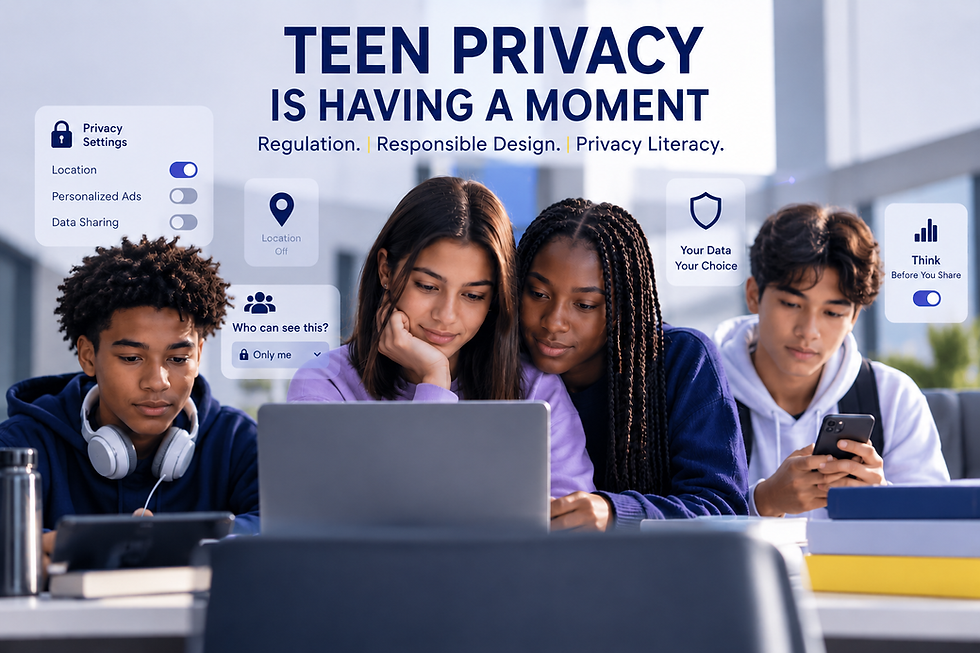
Teen Privacy is Having a Moment & FairFacts Is Taking a Seat at the Table

Parents carry the heavy responsibility of helping manage their children’s online lives, but that responsibility becomes more complicated as children become teenagers. Between the ages of 12 and 18, young people gain more independence, encounter greater peer pressure, and have more opportunities to shape their digital world.
Gaming, social media, online shopping, and even simply browsing the internet can leave behind a trail of information. Tracking technologies can collect signals about what teenagers like, where they go, what they search for, what they engage with, and potentially even who they are.
That raises a bigger question for the businesses building and managing these products and services: How much responsibility should companies have to protect teenagers on their platforms, and what privacy rights should teenagers have for themselves?
That is the conversation already underway, and FairFacts is pulling up a seat to be part of the discussion.
Regulation
Putting regulations in place to protect teenagers is a good start and an important mechanism for holding businesses accountable for the outcomes of their products and services. If a company is aware that its product or service is negatively impacting young people and continues operating without safeguards to reduce harm, there should be consequences.
It is no surprise that 20 states in the United States are enforcing privacy laws that focus on parental consent, account controls, safeguards around minor information and data collection, targeted advertising, and effective age assurance. The EU and UK are also moving toward privacy-preserving and effective age assurance. Australia has taken a particularly interesting approach with the implementation of its Social Media Minimum Age Rules and, just this past March, proposed the Children’s Online Privacy Code, which would require organizations to consider the best interests of children when collecting, using, or disclosing their information.The Australian framework essentially gives children more direct privacy rights and controls, along with greater transparency when parents consent to their data being collected on their behalf.
These changes are only a few examples of how countries are moving toward the collective responsibility of protecting teen privacy and giving young people the tools to participate.
Regulation establishes accountability, and that matters. But regulations can only go so far. They establish a floor for what companies must do. The next question is whether companies will simply meet that floor or use responsible design to build something better.
Responsible Design
Where do businesses come in? Responsible design is both a response to regulations and proactive thought leadership that anticipates public concern and where regulations are going. It means building the necessary controls, minimizing unnecessary collection of data, reducing harmful profiling, and, most importantly, providing young users with tools to manage their time and digital footprint online.
Some examples include:
Minimize the data collected
Does the platform really need a teenager’s precise location, contacts, school information, or other personal information?
Make privacy controls understandable and explainable
A 14-year-old should not need to understand a 40-page privacy policy to figure out what controls and privacy mechanisms are available to them. If an app is collecting information, profiling behavior, or personalizing content, it should explain it in language a teenager can understand.
Make defaults safer
Don’t make the teenager discover privacy settings after something goes wrong.
Give meaningful choices
Don’t give someone a fake choice where the only practical option is “accept.” The option to decline or reject should be clear.
FairFacts sees opportunities for companies to build trust among teens and parents by being part of the solution. This can include in-product messaging, privacy reminders, and tools that give teens and parents greater visibility into how information is being collected and how they are interacting with a platform:
“You are about to share your location. Do you want to continue?”
“This post includes information about where you are.”
Teens are going to make mistakes, so it is important to give them tools to not only mitigate risks, but also correct those mistakes. Make it clear and easy to:
Delete something
Change the visibility of posts and information
Remove a tag
Revoke access
Report someone
Block someone
View what data is being collected and for what purpose
Privacy Literacy
At FairFacts, we believe privacy literacy is an important part of this conversation. That is why we are developing a creative resource to help teens understand their privacy, their rights, and their risks. The goal is not to tell teenagers to stay offline. It is to help them understand the digital world they are already navigating.
My Privacy Is Peace: Teens give teens practical tools to think about what they share, who has access to it, what their digital activity can reveal, and how their choices today can shape their digital footprint tomorrow. It is a creative resource developed with input from teens to ensure that the content is relatable, engaging, and covers the most critical challenges teens are facing online today and in the future.
My Privacy Is Peace: Teen is currently in development, but will be available for purchase on Amazon and at local vendor events, including Sip Shop Eat in San Francisco, this fall.
Conclusion
Teen privacy requires more than one solution. A comprehensive and effective approach includes regulation, responsible design, and privacy education.
Protecting teenagers online is not the same as controlling everything they do online. As young people get older, they need opportunities to make decisions, understand consequences, make mistakes safely, and develop the confidence to protect themselves.
A teenager who knows how to adjust a privacy setting, recognize an inappropriate request for information, question why an app wants access to their location, or think twice before posting something personal is developing skills they can carry with them long after a parental control is removed.
Privacy is not just something we should protect for teens. It is something we should teach them to protect for themselves.
Sources


Comments